From Cell to Billions
From Cell to Billions: The Basement Membrane Skincare Revolution
Since《Cell》first proposed the nine hallmarks of aging in 2013, the scientific community has been piecing together the complete picture of human aging. In 2023, this framework was expanded to twelve hallmarks. Now, in 2025, the latest aging research review published in the top international academic journal《Cell》has made significant updates to the hallmarks of human aging.
Building upon the classical "Hallmarks of Aging" framework, this review further highlights Extracellular Matrix Changes as a core mechanism of human aging.
Fourteen Aging-Related Indicators
Over the past few decades, anti-aging research has primarily focused on: DNA damage repair, telomere attrition, oxidative stress, inflammation control, and cellular energy metabolism. The introduction of the ECM theory has further extended the research perspective to the "ecosystem" on which cells rely for survival, communication, and regeneration.
For the skin, this means that anti-aging strategies are shifting from the traditional "supplementing missing components" to "rebuilding a youthful microenvironment." As one of the most critical structures in the skin's ECM system, the Basement Membrane (BM) is also becoming an important breakthrough point for next-generation anti-aging technologies.
The Basement Membrane — The Most Critical Anti-Aging Node in the Skin's ECM System
The ECM is a complex network structure filling the spaces between cells, composed of macromolecules secreted by cells into the extracellular space. It mainly consists of collagen, elastin, proteoglycans, glycosaminoglycans, and various signal-regulating factors.
In a youthful state, the ECM maintains a dynamic balance: the collagen network is orderly arranged, the elastic structure is intact, and information exchange between cells is smooth. However, with increasing age, the ECM gradually changes, including decreased collagen synthesis, increased degradation, reduced elastic fibers, and a decline in tissue mechanical properties.
Within the skin's ECM, there is a highly specialized structure—the Basement Membrane (BM), also known as the basement membrane zone or Dermal-Epidermal Junction (DEJ). It is an important structure connecting the epidermis and the dermis, and it is also the most functionally concentrated structure in the ECM.
Despite being only 0.1 micrometers thick, the basement membrane performs extremely complex biological functions. It is primarily composed of Type IV collagen, Type VII collagen, Type XVII collagen, laminin, nidogen, and heparan sulfate proteoglycans, which together form a precise network structure.
First and foremost, the basement membrane serves the role of "structural support." It firmly anchors the epidermis to the dermis, maintaining the smoothness, firmness, and elasticity of the skin surface. In a youthful state, the basement membrane exhibits a wave-like structure, which can increase the contact area between the two layers of tissue and enhance mechanical support.
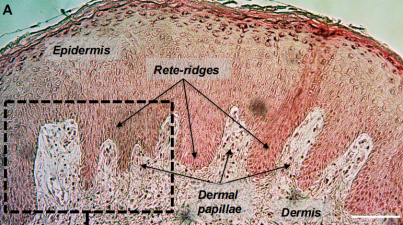
Secondly, the basement membrane is also an important information platform for skin cell communication. Key molecules such as laminin can bind to integrin receptors on the cell surface to regulate the proliferation, migration, and differentiation of keratinocytes.
Furthermore, the basement membrane maintains the ecological environment for epidermal stem cells. Basal layer stem cells rely on adhesion signals and microenvironmental stimulation provided by the basement membrane to maintain their self-renewal capacity. Once the basement membrane is damaged, stem cell stability decreases, and the skin's renewal ability subsequently weakens.
Skin Aging May Begin at the Basement Membrane
The《Cell》review emphasizes that ECM changes are a core hallmark of aging, and the aging of the skin's basement membrane is exactly the most concentrated and intuitive manifestation of ECM aging in the skin.
Multiple studies have revealed the degenerative changes of the basement membrane with advancing age:
Shiseido's research found that the two major causes of basement membrane aging are heparanase and matrix metalloproteinase-9 (MMP-9). These two enzymes are activated under external stimuli such as ultraviolet (UV) rays, accelerating the degradation of the basement membrane. Type IV collagen, Type VII collagen, Type XVII collagen, and laminin-332 are all significantly reduced in naturally aging skin.
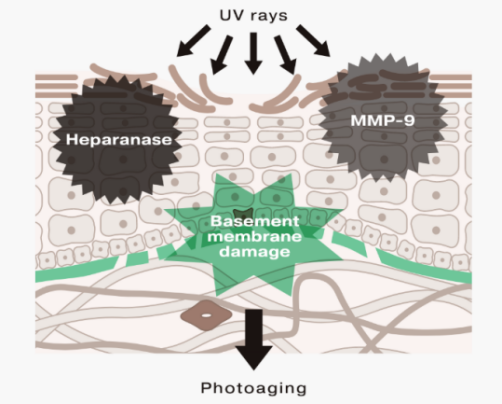
Structural Flattening: The DEJ of young skin is wave-like, greatly increasing the contact area between the epidermis and the dermis. In contrast, the DEJ of aging skin gradually flattens, weakening mechanical support and directly leading to skin sagging and wrinkle formation.
Stem Cell Depletion: The reduction of Type XVII collagen leads to the instability of the hemidesmosome structure, causing epidermal stem cells to detach from the basement membrane and be forced into mature differentiation. Stem cell exhaustion leads to a precipitous drop in the skin's regenerative capacity.
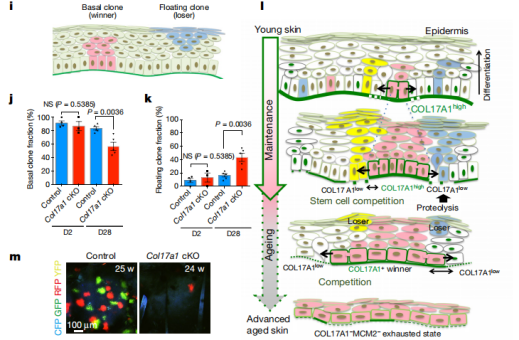
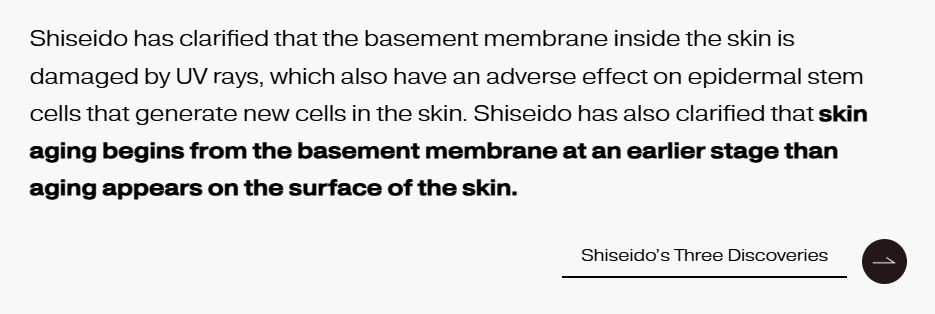
Damage to the basement membrane is the "root cause" of skin aging, not the "result." As Shiseido pointed out in its research:skin aging begins from the basement membrane at an earlier stage than aging appears on the surface of the skin.
Basement Membrane Skincare: The New Growth Pole of the Next-Generation Anti-Aging Industry
The scientific feasibility of basement membrane repair was first validated in the medical field. Numerous clinical cases have shown that exogenous basement membrane materials can effectively guide human tissues to achieve regenerative repair rather than scar healing. This proves that utilizing the basement membrane to regulate tissue regeneration is scientifically feasible.
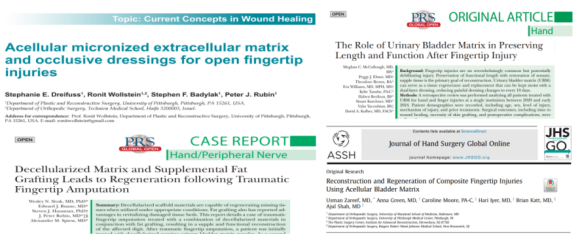
However, the greatest demand for skin anti-aging lies precisely in daily care—preventing and making early interventions before the skin shows obvious wrinkles and severe aging. This is exactly the problem that basement membrane skincare products aim to solve.
Since the 1990s, Shiseido has been focusing on the basement membrane, treating it as a part of photoaging research. Over the past 30-plus years, Shiseido has continuously conducted basement membrane research, screened over 20,000 ingredients, and found components that can inhibit this basement membrane damage.
The L'Oréal Group has also been deeply involved in this field. One of the mechanisms of action of its core anti-aging ingredient, Pro-Xylane, is precisely targeting the reconstruction of the skin's extracellular matrix (ECM). It can initiate the expression of glycosaminoglycans as well as basement membrane-related collagens and proteoglycans, assisting in skin firming.
Estée Lauder began its research on the basement membrane (DEJ) in the early 2000s, early identifying Laminin-5 as a core biomarker of skin firmness. Over the past two decades, it has evaluated thousands of active molecules through high-throughput screening and validated multiple signaling pathways that enhance DEJ key protein expression.
From product layouts on the brand side to technological breakthroughs on the raw material side, the basement membrane is no longer just a scientific concept confined to academic papers; it has become a consensus throughout the entire industry chain, from medical care to skincare, and from raw materials to brands.
The reason this consensus is called a "multi-billion dollar trend" is no exaggeration—what basement membrane skincare anchors is precisely the core sector with the greatest growth momentum in the entire anti-aging track.
Resources:
- Kroemer G, Maier A B, Cuervo A M, et al. From geroscience to precision geromedicine: Understanding and managing aging[J]. Cell, 2025, 188(8): 2043-2062.
- Liu N, Matsumura H, Kato T, et al. Stem cell competition orchestrates skin homeostasis and ageing[J]. Nature, 2019, 568(7752): 344-350.
- Roig-Rosello E, Rousselle P. The human epidermal basement membrane: a shaped and cell instructive platform that aging slowly alters[J]. Biomolecules, 2020, 10(12): 1607.
- https://corp.shiseido.com/beautytechnologylab/en/basement_membrane/part1/
- https://corp.shiseido.com/beautytechnologylab/en/basement_membrane/part2/